Learning to read in a Montessori Kindergarten involves following a natural progression where each child moves at their own pace. At Athéna school in Bailly (78), children aged 2 to 6 discover reading without pressure, thanks to unique materials developed over the past 35 years. Here's how this learning process actually unfolds.
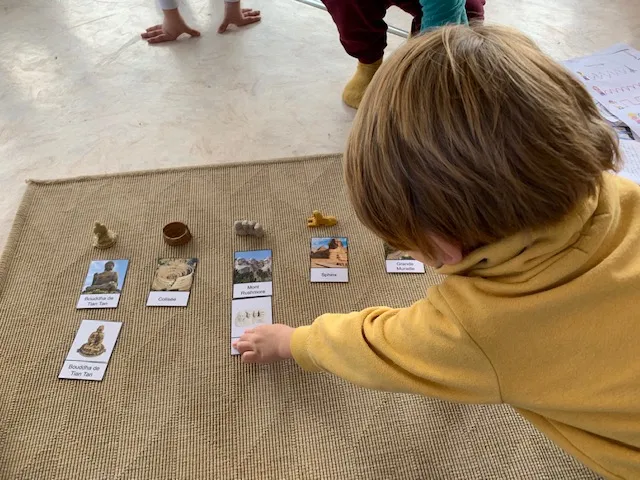
Before touching a letter, children must understand that words are made up of sounds. This is a very abstract concept, which is why Montessori nurseries dedicate time to it, long before introducing the alphabet.
At Athéna, , children start at a very young age with numerous sensory activities, particularly with Montessori bells and sound boxes, to enable them to grasp the concept of sounds. This is followed by group and individual games focusing on phonological awareness.
The game '' my small eye sees''
The educator places three objects on a mat (a ball, a bag, a motorbike) and says: «My little eye sees an object that begins with the sound ssssss, can you give it to me?» The child then takes the bag.
The sound pair game
There are six objects in the form of three pairs that start with the same sound: rabbit and wolf, boat and balloon, cow and bicycle. The educator takes the rabbit and asks: «"Can you find me an object that starts with the same sound as 'rabbit'?"» The child then takes the wolf, and they are placed together. They carry on with the ball, then the cow, until all three pairs have been matched up.
As the class comprises children aged between 2 and 5½, the youngest children hear these games from the moment they arrive and gradually take them on board, well before they are formally introduced to them. A great deal of supplementary material has been created within our nursery school to support this foundational stage.
Once the child understands that words break down into sounds – thanks to the numerous games and materials developed in the classroom – the educator presents the sandpaper letters individually. The child touches the letter with their fingertips while hearing the corresponding sound. This multisensory approach (sight, touch, hearing) is one of the keys to the Montessori method.
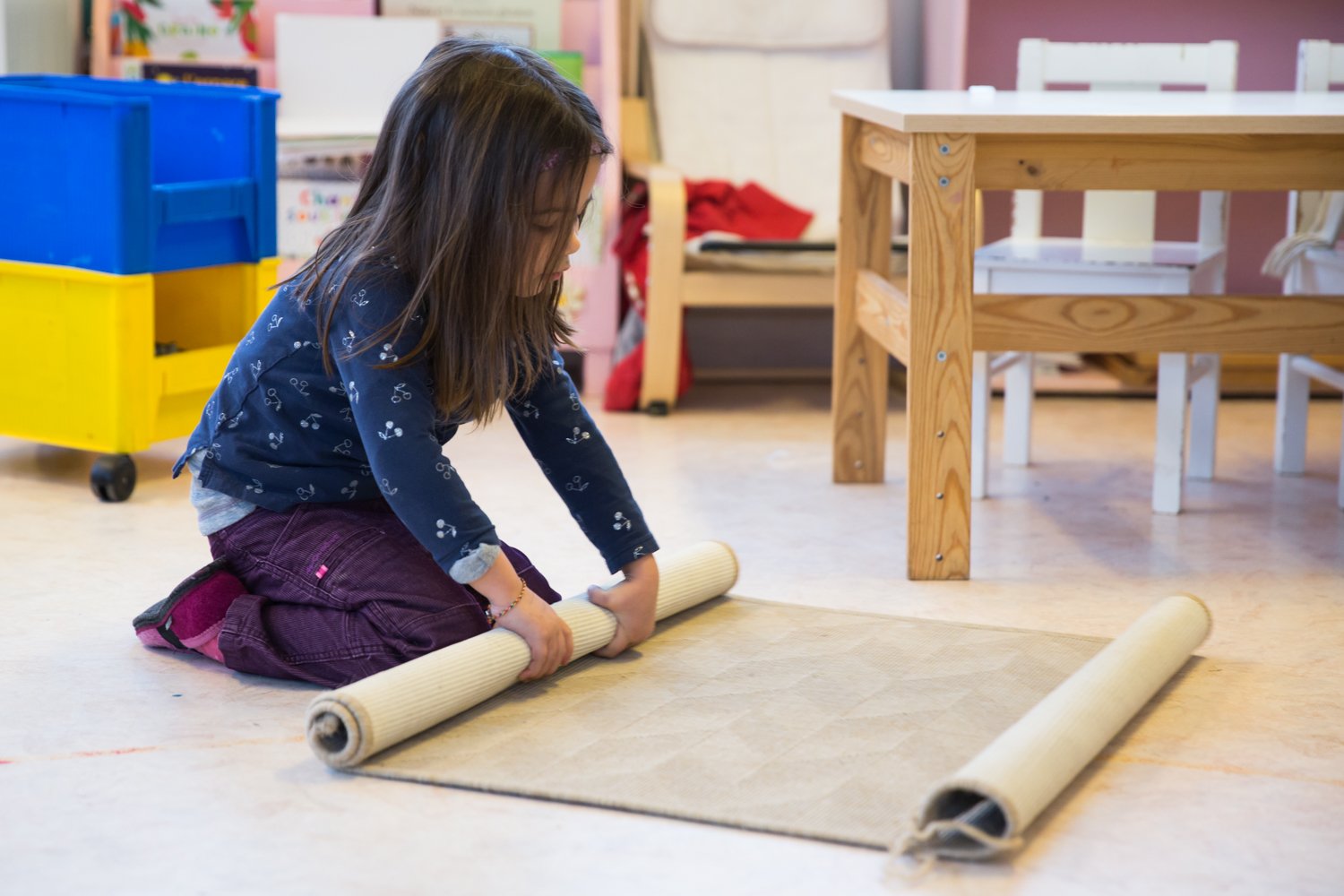
Teaching follows what Maria Montessori called the the three-part lesson, used for all material presentations:
Stage 1 — Name
The teacher places three letters in front of the child (for example, a, m, s) and says: «"Here’s the 'a' – can you touch the 'a'?"» Then: «Here’s the mmm, can you touch the mmm? Here’s the sss, can you touch the sss?»
Stage 2 — Recognising
We swap the letters around and ask: «Show me the mmm. Show me the sss. Show me the a.» We rearrange the letters again and go through the same questions several times. This is the key part of the lesson, the crux of memorisation. If this stage is not handled properly, the child will struggle in the third stage — and that is something we certainly want to avoid.
Stage 3 — Recalling
Show the child a single letter and ask: «"What's that?"» The child must name the sound on its own. We put that letter away and bring out another one: «"What's that?"» And the same goes for the third one.
If the child has succeeded, we conclude: «"Today you’ve learnt three letters: a, mmm and sss. And tomorrow you’ll be able to learnt three more."»
Once a child has learnt a number of rough letters, they move on to a crucial intermediate stage: they associate each rough letter with an object whose name begins with the corresponding sound. This forms the bridge between recognising individual letters and forming words.
This is one of the most surprising principles for parents: in Montessori education, Writing comes before reading. The child always begins by composing words with the movable alphabet before reading them.
Concretely, as soon as the child knows enough letters, they start to compose words with the movable alphabet, a set of cut-out letters that they manipulate freely. We start with two- and three-letter phonetic words.
The child initially finds in boxes Miniature objects from which he will compose the name: bag, thread, bone, gold, screw. He then moves on to boxes containing Images whose name also consists of three letters. He also has boxes in which he is going to match the image of the object with the label for the word the corresponding one: bag, wall, floor, salt, sea, south.
Then the child reads some small booklets composed of two and three-letter words, then short sentences, then real books. In Athens, children use, among other things, «Early independent reading», written by Sylvie d'Esclaibes and Noémie d'Esclaibes, published by Hatier.
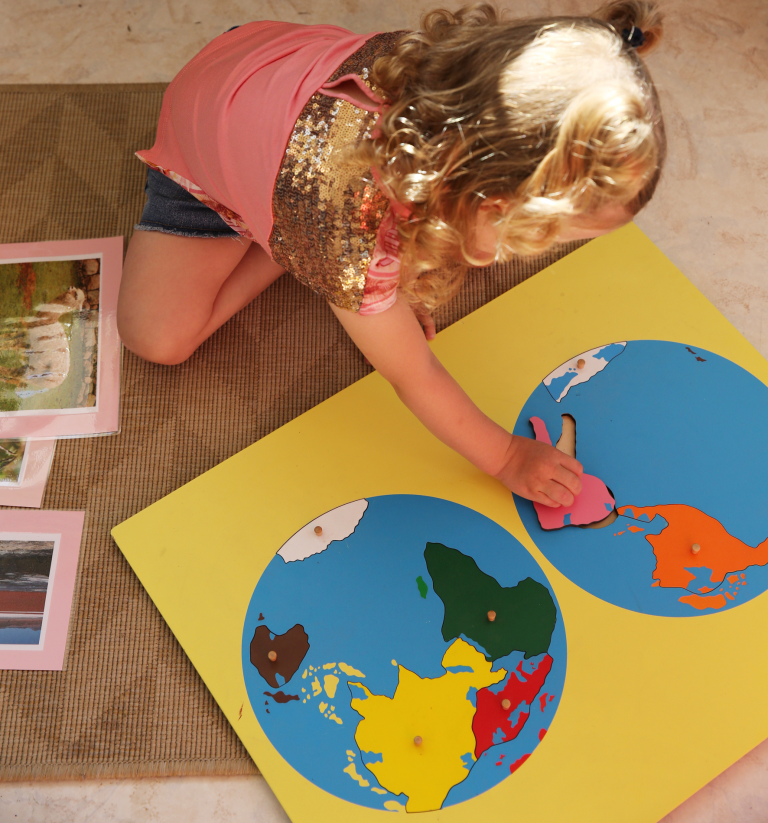
Next, the child moves on with the same sequence to four-letter words, then five, then six. The educator gradually introduces the digraphs (ch, in, on, an, ou), always following the same progression: manipulation, composition, then reading. Each child progresses at their own pace, of course. Everything is individual.
Sylvie d'Esclaibes, the school's director and founder, also created the collection «Little Montessori» as well as «My Montessori Reading Method» Published by Hatier. Numerous supplementary materials and workbooks, developed over 35 years, are made available to children in the classroom.
What can be said is that in our school's nursery classes, very important reading material has been developed and created over the past 35 years so that every child can learn in the best possible conditions.
One of the most common concerns for parents is: «What if my child isn't ready?»
In a Montessori nursery, children are observed closely, and it's not stated that they aren't ready to read; we wait until they are. Regularly, the educator individually offers games based on sounds, and one day the penny drops.
If the breakthrough doesn't come spontaneously, the educator simply suggests: «Today I'm going to introduce you to three letters, will you?» No constraints, no pressure, no failure.
The Athéna Montessori school in Bailly has welcomed children since 1991. Over 35 years, the teaching team has developed, tested, and refined a unique reading material, supplemented by the numerous works published by the director. This is not a theoretical method: it is the result of daily observation of thousands of children who have learned to read at their own pace.
Our Montessori bilingual nursery welcomes children aged 2 to 6 in Bailly, Yvelines (78), with full immersion in both French and English and small class sizes (maximum 15 pupils).
Would you like to know more about our teaching approach or enrol your child? Discover our Tuition fees or read the Testimonials from our families.
Do you have any questions about learning to read or about our school?
Talk to the management